From what i can gleam from Nausicaa by Studio Ghibli on the subject of human nature is similar to what i have found other science fictions i have encountered (which i plan to discuss in my essay) That message seems to be that human nature at present is destructive and will lead to our demise if we do not evolve in the way we think and the way our mind as a species works. It says our nature can evolve, usually shown by the protagonists actions and their disposition but our current nature which while this part is fading is still one of violence and bloodshed.
One of the main focuses of the film involves the main character using a glider, this reflects her nature and how she is not a person of violent nature, one of the first things she does is save a man from a humugus bug via quelling its anger and bringing it back to the forest. She is then bitten by a scared creature to which she stays still does nothing and continues to try and clam it down to which it responds positively and licks her wounds. Her flying is a representation of her ascension from the old human nature and into a new more peaceful disposition.
There is more symbolic representation of that displayed early on in the film when a flying ship from another nation is plummeting to the ground and then crashes, the ship is built by (spoilers) a nation who are planning on resurrecting a great titan creature that where used on mass which caused the downfall of old human civilization, these creatures i feel represent our more violent primitive human nature since they destroyed the old society of man and the people who wish to bring them back to life wish to use them for violence and are the antagonists to Nausicaa.
When Nausicaa is pushed to violence early on in the film when the antagonistic force first arises and kills one she cares for dearly she is stopped by a wise mentor character and when she realises what she has done she is horrified with herself, the sound of the blood dripping rings loud in her ears and she looks on in fear at what she has done.
Showing posts with label Contextual. Show all posts
Showing posts with label Contextual. Show all posts
Friday, 31 January 2014

Tuesday, 28 January 2014
Lucky Day Forever short sci-fi film
http://www.shortoftheweek.com/2012/09/11/lucky-day-forever/
This is a Sci-Fi short animation that explores hierarchy and a grass is greener scenario and also a very interesting take on an image and sex obsessed society not too disimalar from the quintisential MTV style audiance.
I'm not entirely sure why but this strange future/alternate world got into my brain and unsettled me for a day or two and i think that the world which is created in this animation is meant to provoke that kind of emotional reaction.
While it's world isn't the most original concept ever, being most reminiscent of the sci-fi worlds created in the film Cloud Atlas it focuses on a slightly different subject and its overuse of joyous smiley faces and blunt sexual imagery made me feel like the world was real and that i was unnerved by its constantly smiling ego centric higher class species.
This is a Sci-Fi short animation that explores hierarchy and a grass is greener scenario and also a very interesting take on an image and sex obsessed society not too disimalar from the quintisential MTV style audiance.
I'm not entirely sure why but this strange future/alternate world got into my brain and unsettled me for a day or two and i think that the world which is created in this animation is meant to provoke that kind of emotional reaction.
While it's world isn't the most original concept ever, being most reminiscent of the sci-fi worlds created in the film Cloud Atlas it focuses on a slightly different subject and its overuse of joyous smiley faces and blunt sexual imagery made me feel like the world was real and that i was unnerved by its constantly smiling ego centric higher class species.
Wednesday, 22 January 2014
Essay Writing
In contextual on Monday, Kim went through with us the specifics of qouting and paraphrasing. He then gave us a group of qoutes about television and violence, some saying there connected some saying the opposite. He asked us to do a small example of paraphrasing and this is what i came up with.
"Many people believe that TV violence
causes real violence, either indirectly or directly. For instance
Smythe reports (1998) in a court case a defence attorney tried to
absolve his client by solely blaming television therefore taking all
responsibility for the acts off of the person on trial.
This sort of behaviour disgusts me that
a murderer could potentially get an easier sentence because the
attorney blamed all wrong doings on the television saying “he had
frequently watched violent TV shows and was therefore pushed into
acting” (Smythe 1998:45). In contrast Martin writes in his case
study in (1981) that there is no direct connection between violent
images on television and violent behaviour in adolescence.
While Martin's case study would suggest
no direct link between TV violence and the real thing, Fischer and
Hoffman write (1990) Countries with high controls on television, like
Sweden and Norway, have lower crime rates. Though this particular
phenomenon could be contributed to other factors."
I do apologize for not writing down said quotes it slipped my mind, would of definitely made a more interesting experiment if you could have seen the quotes from which my paraphrases where derived.
Nope i looked on the PCA moodle to see if the quotes where up on there and they are not unfortunately, oh well you can't have everything. Kim also set us a task to write 1200 words of our contextual essay as a first draft by the 10th of February so i will be getting on with that soon.
Tuesday, 21 January 2014
Looking at Nine and its Human Nature messages
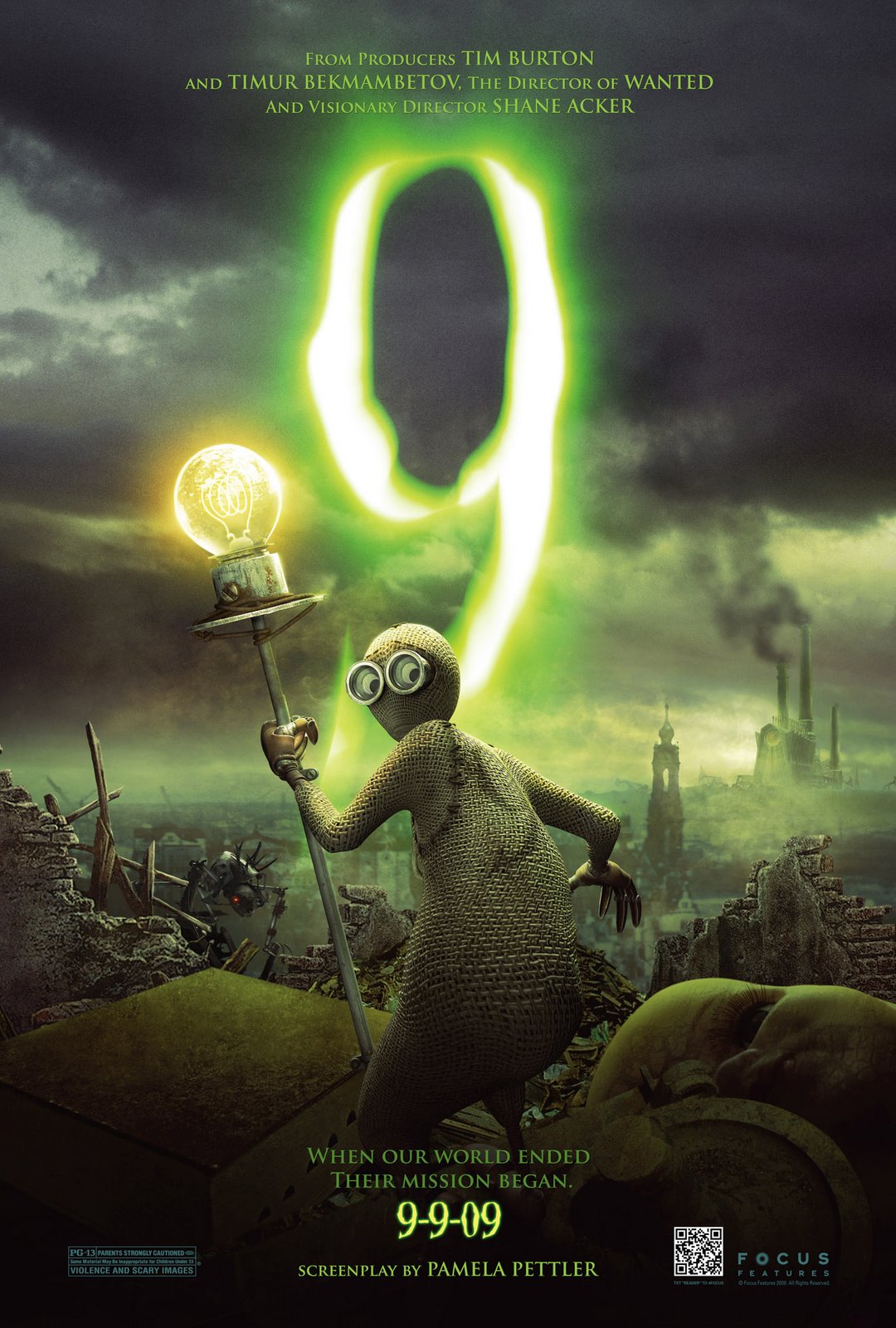
The plot is an un-named scientist who created a sentient robot out of his own intelligence using o combination of science and because of a strange device that seem to literally put his intelligence into it a tad of magic i can only assume. He created it for progresses sake but he says that he didnt give it a soul it was easily manipulated by anyone who controlled it, inevitably people used it for war and violence sake and in the end it turned against us. This was all told in exposition via a recorded message but its not the hardest thing to discern. To remedy this he created nine little robot sack things he creatively named one, two, three four and so on in that fashion. He then split up his soul and put it into the nine sack things and tasked them with undoing his mistake and destroying the robot that he so long ago breathed life into.
As you can imagine, the splitting up of a persons soul into nine parts is a very good premise with which to make a situation where there are few people around and they are all very different personality types since they i'd imagine would all be different elements of the one person who they were created from.
A very interesting outcome of this was the character dynamics that emerged. For instance One was a controlling old man who wore a pope hat and a cape, he was clearly the ego centric controlling part of the scientists personality. He uses Eight (Who seems to be the stronger more violent one) as a pawn to control the others and give himself absolute power.
The main protagonist of the piece of course is Nine, I'm not sure exactly how to define Nine. Most of the characters in this while definitely being quite archetype aren't simple minded one emotioned automatons, despite being made out of only a segment of a soul they do seem to express full personalities but simply are much stronger lead by one particular part of their personality, I would say Nine is more representative of curiosity, considering it is his curiosity that both gets them into bad situations and gets them out of it too.
While that is all interesting and the interplay between the characters is an interesting study itself on archetypes and their interaction with each other, the main look into human nature comes from the back story and its relationship to the overarching plot. In the back story as i said earlier in the post us humans took this pure creation and as we do used it for violence (As is unfortunately in our nature) and then that folly of our old propensity for violence and conflict thanks to our more primitive nature we got ourselves all killed. The main thing that the scientist wanted the nine parts of his soul to do was make up for his mistakes, they are in effect the new inhabitants of Earth here, they are the next stage of humanity and during the plot of the film they make up for their creator/their/their ancestors mistakes and come to a new level of understanding and have in effect overcome the more negative aspects of human nature and have emerged the new and improved human race, free of the old nature of violence and conflict being a constant need.
Monday, 20 January 2014
Mass Effect's species and Human Nature
In this post I am going to look at the designs of the Krogan and Salarians (The aliens from the Mass Effect series which i talked about in a previous blog post about representing the primitive side of human nature and the elevated civilized side of it)
First off we will analyses the appearance of the Krogen and see how if at all it's design has any presence of the primal violent nature of man or something which represents that. For those of you who have not played Mass Effect, and as a visual aid so we can both explore the design together, i will have a picture posted.

 As you can see the Krogan features are strong, heavy, thick brow's, hunched back and small eyes. The thick eyebrow ridges arching over there eyes and the big hunched back obviously make them imposing but also (At least in my mind) cause them to look rather neanderthalic and a little gorilla like. That i would say supports my theory of them representing the more primal violent urges of human nature. They do posses features that are reasonably reptilian and in looking at these images i cant deny how there mouths and necks look a little turtle like but i assume those are small ascetic choices simply to make them look alien and to be adventurous with their design.
Take a look at the Krogans armor choice, looking at it i would say it strongly resembles medieval armor. Maybe not at first glance but compared to the armor of other races in the Mass Effect universe (For reference scroll down to compare to Salarians) it does have much more of an old battle armor style to it.


These in contrast are the Salarians. Looking at their design it is easy to discern they are much more classical alien, considering there appearance is more similar to the classical grey aliens that have been prevalent in media since the idea of aliens first came about. The Salarian clothing and armor is very reminiscent of things that are quintessentially "futuristic" in our eyes, the armor is classically futuristic with the smooth curves and matte colours on glossy under colours which i can't help think looks a little like something apple would make. There design is completely juxtaposed to the Krogan in everyday, from their slight frame to their large eyes to their fairer features they have been specifically designed to be the opposite of the Krogan.
While the Salarian aren't as obviously linked in there design to human nature as the Krogan are i still feel there juxtaposition/relationship to the Krogan shows there relation to the role i think they take as a representative of the more civilized side of humans suppressing the more violent and primal tendencies of human nature.
First off we will analyses the appearance of the Krogen and see how if at all it's design has any presence of the primal violent nature of man or something which represents that. For those of you who have not played Mass Effect, and as a visual aid so we can both explore the design together, i will have a picture posted.

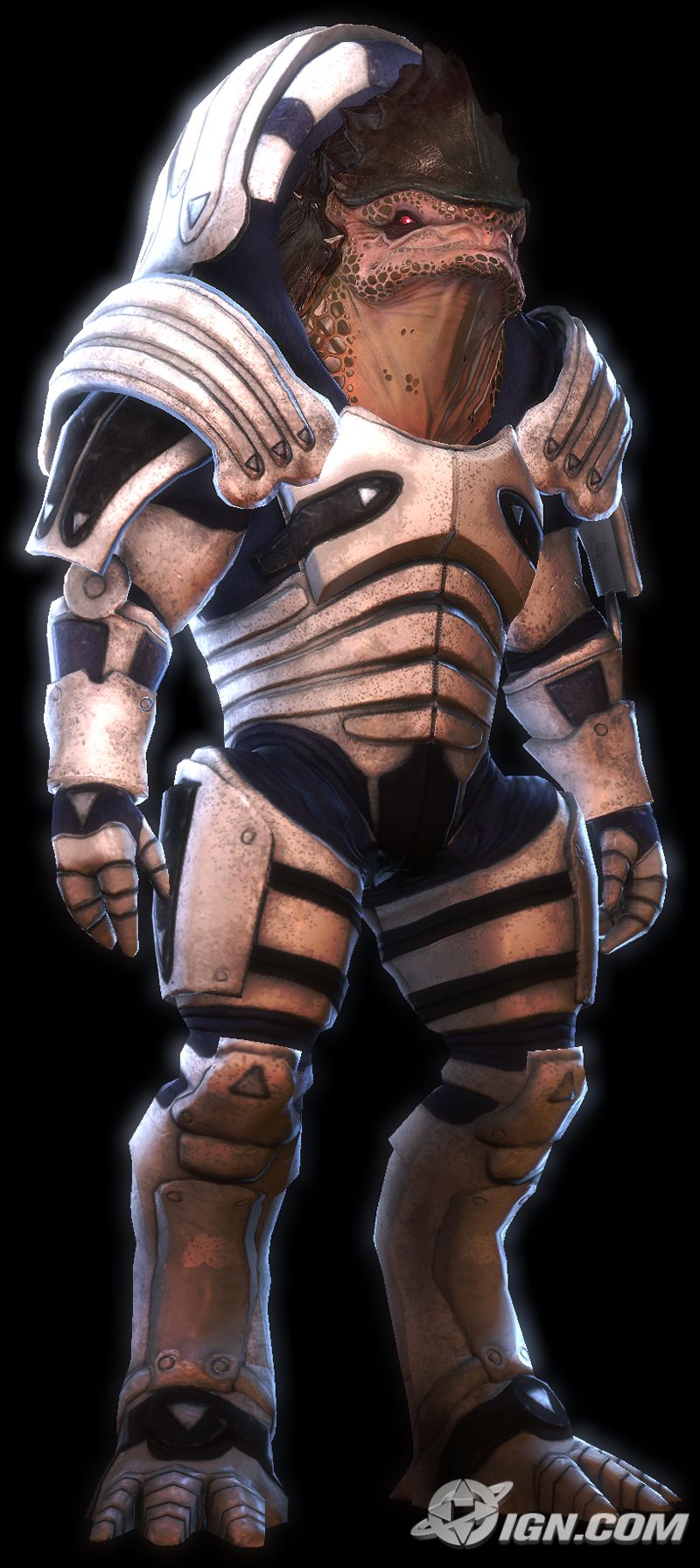 As you can see the Krogan features are strong, heavy, thick brow's, hunched back and small eyes. The thick eyebrow ridges arching over there eyes and the big hunched back obviously make them imposing but also (At least in my mind) cause them to look rather neanderthalic and a little gorilla like. That i would say supports my theory of them representing the more primal violent urges of human nature. They do posses features that are reasonably reptilian and in looking at these images i cant deny how there mouths and necks look a little turtle like but i assume those are small ascetic choices simply to make them look alien and to be adventurous with their design.
Take a look at the Krogans armor choice, looking at it i would say it strongly resembles medieval armor. Maybe not at first glance but compared to the armor of other races in the Mass Effect universe (For reference scroll down to compare to Salarians) it does have much more of an old battle armor style to it.
These in contrast are the Salarians. Looking at their design it is easy to discern they are much more classical alien, considering there appearance is more similar to the classical grey aliens that have been prevalent in media since the idea of aliens first came about. The Salarian clothing and armor is very reminiscent of things that are quintessentially "futuristic" in our eyes, the armor is classically futuristic with the smooth curves and matte colours on glossy under colours which i can't help think looks a little like something apple would make. There design is completely juxtaposed to the Krogan in everyday, from their slight frame to their large eyes to their fairer features they have been specifically designed to be the opposite of the Krogan.
While the Salarian aren't as obviously linked in there design to human nature as the Krogan are i still feel there juxtaposition/relationship to the Krogan shows there relation to the role i think they take as a representative of the more civilized side of humans suppressing the more violent and primal tendencies of human nature.
Sunday, 19 January 2014
Introspection via Essay
I continued to read the essay where i had previosly qouted and commented on in a previous research blog post, and the person writing said something that really gave me pause for thought, what it said in the essay was "How Butler portrays politics is intimately related to her vision of human nature as a biologically-determined entity. The public arena of politics, where dialogue and dissent occur, is nullified in most of her novels by her construction of permanent states of emergency, which pre-empt any full exploration of moral and ethical dimensions of political decisions; there can be no room for real debate when the very survival of the individual or group is at steak. Furthermore, the relationship between ruler and ruled is never egalitarian for Butler, but is always a matter of dominance and submission consistent with her essentialist view of human nature. In Dawn, for example, the aliens unilaterally appoint Lilith to leadership position. Since human nature is for Butler a known, finite, and unchanging entity, she cannot view human politics other than deterministically; not as an open-ended series of unfolding events latent with possibility, but as a process whose result is foregone and predictable. For her, human politics is not an arena for the exercise of choice or freedom, and it offers no opportunities for the improvement of the human condition." and this made me realise that previously i had always assumed that human nature was an unchanging thing that was set in us, only now do i realise that just as we as animals are constantly changing and evolving so is our nature, so the idea that deep in the future we could be smarter more enlightened beings is not completlely out of the question as i had previously though.
Thursday, 16 January 2014
Finally found a human nature/sci-fi essay
I found a brilliant essay which talks about human nature in sci-fi, it took a serious amount of searching, more than it should have really this is an interesting subject dammit why does no one seem to have written about it on the internet. But i digress the essay while being good does unfortunately require you to register with a site but it was a small price to pay to finally find an essay that deals with human nature in sci-fi i mean what the hell why does no one... sorry i digress again, what i was saying was the essay starts off talking about the female role in sci-fi and how feminist writers have made many books where there is a feminist utopia with equal rights. I know what you thinking "How on earth does this have anything to do with human nature Peter, it seems more like a cultural issue, you have gone completely mad, mad i say!" but hold your horses, you see one of those writers in her book had a post apocalyptic situation in which survives of the human race where picked up by these aliens known as Oankali and it says "They are both repelled and fascinated by the human genetic structure. from the perspective of these aliens, Humans are fundamentally flawed as they are both intelligent and hierarchical, a lethal combination in the eyes of the Oankali." suggesting that human nature is essentially flawed in sustaining a peaceful society.
The essay goes on to say that "Butler (The Author) believes that human nature is fundamentally violent and therefore flawed. The origin of violence, she suggests, lies in the human genetic structure, which is responsible for the contradictory impulses towards intelligence and hierarchy. These two conflicting impulses inevitably propel Humans to wage war." While i see where she is coming from and do agree that human nature is innately violent i would not call that a flaw, or something strictly Human for that matter. For any animal to gain the food chain dominance we have which allowed us to evolve to the point we are now we need to be an innately violent creature or else we would never have become dominant as we have, and I would bet you anything that if any other animal on our planet ended up gaining sentience they would be just as violent. Whether this would be the case on other planets with life remains to be seen, i have never visited one so I am definitely not qualified to make that assumption, though unless their energy intake is one of photosynthesis and there is no animals that feed on other animals and they reproduce a sexually so no resource limitation and therefore competition at all, then if a species from there gained sentience they would probably be extremely benign. Considering photosynthesis is energy derived from the sun so the higher the better, i would imagine they would have a thing about being tall though.
The essay goes on to say that "Butler (The Author) believes that human nature is fundamentally violent and therefore flawed. The origin of violence, she suggests, lies in the human genetic structure, which is responsible for the contradictory impulses towards intelligence and hierarchy. These two conflicting impulses inevitably propel Humans to wage war." While i see where she is coming from and do agree that human nature is innately violent i would not call that a flaw, or something strictly Human for that matter. For any animal to gain the food chain dominance we have which allowed us to evolve to the point we are now we need to be an innately violent creature or else we would never have become dominant as we have, and I would bet you anything that if any other animal on our planet ended up gaining sentience they would be just as violent. Whether this would be the case on other planets with life remains to be seen, i have never visited one so I am definitely not qualified to make that assumption, though unless their energy intake is one of photosynthesis and there is no animals that feed on other animals and they reproduce a sexually so no resource limitation and therefore competition at all, then if a species from there gained sentience they would probably be extremely benign. Considering photosynthesis is energy derived from the sun so the higher the better, i would imagine they would have a thing about being tall though.
Monday, 13 January 2014
Soylant Green, Mass Effect and Human Nature
I watched Soylant Green hoping to get a good reflective sci-fi and I am aware of its theme and plot and how it is heavily to do with our culture and the encroaching overpopulation issue and brings it to a rather frightening logical conclusion if we continue treating the world and ourselves the way we currently do, or currently did in the 70's at least (its an old film)
While the film had a lot to do with culture (which is one of the many appendages of human nature is not exactly what im focusing on) it didnt have massive amounts to do with human nature as a topic, actually. There is a main character who is our way into the world, he is an old man who was alive when people still ate meat and real food and not just products from the Soylant company. His son (who is the main character) says to him at one point about how he said people where better back in the old days, and he replies "I never said people were better, people have always been dirtbags. The world sure was prettier though" I'm paraphrasing by the way i dont remember exactly what he said but it was along that jist. What he said there is an interesting stab at human nature, because no matter how advanced we get human nature is always the nature of an animal that needs to fight for survival and unfortunatly fighting for survival involves being rather mean to others and caring for your own survival so dosnt make for the nicest people.
Thinking of it most sci-fi's (particularly the ones with alien races) are mostly personified parts of human nature and our battle against it to be civilised. For instance in almost all alien sci-fi's there is the big tough strong alien, usually savage, warlike and tribal representing the animalistic part of human nature and then to juxtapose them the enlightened, civilised and usually sceintific aliens who represent our new civilised ideals that fight to control the anamalistic part of our nature, and this is just a wild stab in the dark but i bet usually those two species are at war or are at least unfreindly towards each other.
In one sci-fi game specifically called Mass Effect the tribal, warlike, violent species the Krogans where almost completely wiped out by the civilized scientific race called the Salariens, which now i realize is a pure representation of us trying to supress and hide our violent animalistic side with our new more civilized selves... also i just realised that even though the Salariens used a biological weapon to try and get rid of the Krogan the animelistic Krogan still managed to survive even if in reduced numbers showing how the more civilized side of us can never truly oust our nature.
While the film had a lot to do with culture (which is one of the many appendages of human nature is not exactly what im focusing on) it didnt have massive amounts to do with human nature as a topic, actually. There is a main character who is our way into the world, he is an old man who was alive when people still ate meat and real food and not just products from the Soylant company. His son (who is the main character) says to him at one point about how he said people where better back in the old days, and he replies "I never said people were better, people have always been dirtbags. The world sure was prettier though" I'm paraphrasing by the way i dont remember exactly what he said but it was along that jist. What he said there is an interesting stab at human nature, because no matter how advanced we get human nature is always the nature of an animal that needs to fight for survival and unfortunatly fighting for survival involves being rather mean to others and caring for your own survival so dosnt make for the nicest people.
Thinking of it most sci-fi's (particularly the ones with alien races) are mostly personified parts of human nature and our battle against it to be civilised. For instance in almost all alien sci-fi's there is the big tough strong alien, usually savage, warlike and tribal representing the animalistic part of human nature and then to juxtapose them the enlightened, civilised and usually sceintific aliens who represent our new civilised ideals that fight to control the anamalistic part of our nature, and this is just a wild stab in the dark but i bet usually those two species are at war or are at least unfreindly towards each other.
In one sci-fi game specifically called Mass Effect the tribal, warlike, violent species the Krogans where almost completely wiped out by the civilized scientific race called the Salariens, which now i realize is a pure representation of us trying to supress and hide our violent animalistic side with our new more civilized selves... also i just realised that even though the Salariens used a biological weapon to try and get rid of the Krogan the animelistic Krogan still managed to survive even if in reduced numbers showing how the more civilized side of us can never truly oust our nature.
Human Nature reaserch
This is a book that discusses human nature in its basest of elements (at least in the first part) it discusses what even is human nature what is it derived from. Which i have to say is interesting to contemplate but simply via seeing how humans have developed the things we have in common and differentiate us from people who developed their cultures and beliefs completely separate from us makes evident what is nature and what is learned.
Idea Refining
I'm thinking of refining my idea down to human natures representation in sci-fi as apposed to culture. While culture is heavily based on human nature i feel that is a more specific subject that while having the potential to branch out into culture can also remain more specialized if need be.
Quotes that aid my looking into culture in Sci-Fi
Last and First Men, by Olaf Stapledon, Preface
"To romance of the future may seem to be indulgence in ungoverned speculation for the sake of the marvellous. Yet controlled imagination in this sphere can be a very valuable exercise for minds bewildered about the present and its potentialities. Today we should welcome, and even study, every serious attempt to envisage the future of our race; not merely in order to grasp the very diverse and often tragic possibilities that confront us, but also that we may familiarize ourselves with the certainty that many of our most cherished ideals would seem puerile to more developed minds. To romance of the far future, then, is to attempt to see the human race in its cosmic setting, and to mould our hearts to entertain new values."
Science Fiction after 1900: from the steam man to the stars, by Brooks Landon, P 109
"Utopian and dystopian SF works regularly interrogate political and social norms, frequently, if not usually, advancing a generally libertarian philosophy that mistrusts authority in all it's official guises. And yet, for all it's trappings of iconoclasm, SF in the twentieth century has also been uncritically supportive of far too many totalizing systems of belief and has blithely accepted far too many cultural constructions as immutable aspects of reality."
"To romance of the future may seem to be indulgence in ungoverned speculation for the sake of the marvellous. Yet controlled imagination in this sphere can be a very valuable exercise for minds bewildered about the present and its potentialities. Today we should welcome, and even study, every serious attempt to envisage the future of our race; not merely in order to grasp the very diverse and often tragic possibilities that confront us, but also that we may familiarize ourselves with the certainty that many of our most cherished ideals would seem puerile to more developed minds. To romance of the far future, then, is to attempt to see the human race in its cosmic setting, and to mould our hearts to entertain new values."
Science Fiction after 1900: from the steam man to the stars, by Brooks Landon, P 109
"Utopian and dystopian SF works regularly interrogate political and social norms, frequently, if not usually, advancing a generally libertarian philosophy that mistrusts authority in all it's official guises. And yet, for all it's trappings of iconoclasm, SF in the twentieth century has also been uncritically supportive of far too many totalizing systems of belief and has blithely accepted far too many cultural constructions as immutable aspects of reality."
Wednesday, 8 January 2014
Contextual question 6
One thing
Brooks Landon was saying in science fiction after 1900 was about how in
almost all science fiction works they stuck to certain cultural ideals
and took them as rules of reality rather than cultural constructs that
they are, he made example of in how many sci-fis they have women and men
in the same gender roles as there are in our society. (Edit: when he said that he was talking about older sci-fi not current, i got a bit ahead of myself with the taking notes thing)
Should potentially look at Phillip K Dicks works
I could
potentially go into human nature as it is the cause for most culture and
is much more relevant in miniaturised culture such as when you get
small groups of people form a miniature society. Though I suppose that
isn’t so much culture really that is much more strongly linked to human
nature because when there is a small groups of people in dire situations
creating societies they usually are already from a different culture
and are already bringing in prejudices and ideals from that.
Though I
suppose that could be an interesting look into how brining in the ideals
of a larger culture and trying to apply it to a small survival
orientated society as apposed to the much larger consumer based society
the people would have come from.
Oh wait I
know a film where there is a small society where the occupants don’t
come from any previous culture so it is more an exploration in culture
forming while still being a suaray into human nature (actually human
nature is kind of a theme of the whole film) its the film 9, I will have
to look at that.
These are some games that i could look into as well
Bioshock is also an interesting show of culture in sci-fi (steampuny kind of past sci-fi granted by sci-fi none the less)
Fallout
Mass Effect
Contextual question 5
This contextual lesson has been very helpful, Kim went over how he
marks them to make sure we know what are the criteria of marking is by
showing us a previous essay. We went through the learning outcomes one
by one going over how the essay filled their criteria.
It was rather helpful but what was more helpful was the chat afterwards where i discussed with Kim about the idea for my essay. My idea went though a bit of a metamorphosis and it now is more along the vein of culture being represented in sci-fi though i am still researching and haven’t nailed down quite what the question will be yet.
It has made even more progression since i came into the library to research the idea and i feel i may focus on human nature as well being represented in sci-fi and its impact on culture.
It was rather helpful but what was more helpful was the chat afterwards where i discussed with Kim about the idea for my essay. My idea went though a bit of a metamorphosis and it now is more along the vein of culture being represented in sci-fi though i am still researching and haven’t nailed down quite what the question will be yet.
It has made even more progression since i came into the library to research the idea and i feel i may focus on human nature as well being represented in sci-fi and its impact on culture.
Contextual question 4
I found another essay that wasn’t sent by the tutor (how ingenious of
me aye) I would paste some snippets of it here but people don’t seem to
be very good at formatting their essays so if i copy it there are
paragraphs between each letter which needless to say makes for an
awkward reading experience.
“It is infact difficult to tease the two apart from each other, since it is impossible to participate in anime fan culture, except at the very shallowest level, and not be exposed to other forms of Japanese popular culture and traditional Japanese culture, and thereby be encouraged to explore them further.”
There’s a quote from it, i know i said i couldn’t copy paste quotes so i just wrote that one down because it is strongly linked to my question of “How strongly does Anime represent Japanese culture?”
“It is infact difficult to tease the two apart from each other, since it is impossible to participate in anime fan culture, except at the very shallowest level, and not be exposed to other forms of Japanese popular culture and traditional Japanese culture, and thereby be encouraged to explore them further.”
There’s a quote from it, i know i said i couldn’t copy paste quotes so i just wrote that one down because it is strongly linked to my question of “How strongly does Anime represent Japanese culture?”
Contextual question 3
My previous question was “How strongly does Japanese culture leak
into their unique animation known as anime?” well i think it was at
least it was a bit ago i came up with it and a lot of ident stress and
deadlines and all sorts has happened in that chunk between initial
conception and now.
To be honest that previous question (if that was indeed the question i asked) has all but been answered, Very strongly is the answer. Just from this amount of research it is clear to see that anime and Japanese culture are linked intrinsically, and while you could argue that any thing made by a creator holds within it some remnant ideas from the culture they were raised in it seems anime/manga wasn’t just made as a “hey lets do some animation, how about in this style aye? pretty distinctive right?” it literally had it’s conception via a clash of cultures and i always find someone is most true and holding close their cultural ideals and ways when someone is challenging them.
So anime’s birth was during a time of people having their culture compared to and clashing with another creating a sort of cultural supercharge that was then channeled into the work and to this day that seems to of stayed true. Even in American made anime’s they still retain within them the cultural implications and visual shorthands of Japan almost like even though another culture is making that particular piece the Japanese culture is so strongly linked with the anime style and art form that it is almost impossible to separate the two.
To be honest that previous question (if that was indeed the question i asked) has all but been answered, Very strongly is the answer. Just from this amount of research it is clear to see that anime and Japanese culture are linked intrinsically, and while you could argue that any thing made by a creator holds within it some remnant ideas from the culture they were raised in it seems anime/manga wasn’t just made as a “hey lets do some animation, how about in this style aye? pretty distinctive right?” it literally had it’s conception via a clash of cultures and i always find someone is most true and holding close their cultural ideals and ways when someone is challenging them.
So anime’s birth was during a time of people having their culture compared to and clashing with another creating a sort of cultural supercharge that was then channeled into the work and to this day that seems to of stayed true. Even in American made anime’s they still retain within them the cultural implications and visual shorthands of Japan almost like even though another culture is making that particular piece the Japanese culture is so strongly linked with the anime style and art form that it is almost impossible to separate the two.
Contextual question 2
Still doing research, i recently found out that the population crisis
(there is a bit of a population crisis in Japan at the moment by the
way) is starting to be covered or at least the deeper meaning of it is
leaking into the ideas and themes of anime’s and manga that are
currently being made. I don’t know of the validity of that claim, it was
made by a friend not from any super reputable source but they seem
reliable and what i have read so far would lend that to be a distinct
possibility with Japan injecting their cultural messages heavily into
anime (also no matter what person is making a story, while obviously the
individual brings there own personal prejudices and ideals into that
world the prejudices and ideals ingrained into them by growing up in a
certain culture will always shape their inner psyche and hence their
stories) so that would make a lot of sense, need to look into it
further.
I am currently reading an essay supposedly to do with Japan getting western culture imposed onto it then taking it and making it into something there very own, though so far all they have talked about is the definition of the word cute, also the old definition of the word cute which is sharp as in smart and other things along that vein which i found very interesting but which i have yet to see how it is relevant to be honest.
I am currently reading an essay supposedly to do with Japan getting western culture imposed onto it then taking it and making it into something there very own, though so far all they have talked about is the definition of the word cute, also the old definition of the word cute which is sharp as in smart and other things along that vein which i found very interesting but which i have yet to see how it is relevant to be honest.
Anime, the representative of Japan… inspired by Americans? but still very Japanese (contextual question)
After reading a essay on the history of the Japanese animated form of
anime and the comic form of manga i have found that the anime style is
heavily inspired by Disney, during WW2 when the Japanese first started
creating animated films they had secret copies of Disney films produced
at the time to watch as inspiration for the movement and art style of
their animations. This surprised me for i had no idea of how directly
the anime creators of the past had taken and been inspired by western
animation. Though wile western animation did heavily inspire the
original anime’s, anime is still very much Japanese in cultural messages
and heritage. “As many scholars of modern Japan point out, manga has
become a part of our culture. As literature, films, music and other arts
and reflections of the society, so too are manga and anime.Manga
depicts almost every aspect of life in Japan, from pure entertainment to
educational, instructive and even metaphysical fields.” The Illusions
of Life 2, Kosei Ono.
Essay Question
I had a discussion with the contextual tutor about the question i
would be using to write my essay on. While i did not have a definite
question in mind i had an idea that had gotten stuck in my head to do
with culture and its impact in storytelling and symbolism in animation
specifically the difference between traditional western animation and
anime since they are produced by western and Japanese makers and will
therefore have a completely different cultural spin put into the base of
everything from their world building to their character archetypes.
We soon narrowed it down a tad to simply looking into Japanese culture and how it is represented in anime which as he put it was a good jumping off point. I’m looking forward to see where my research takes me and how i specialize and narrow down my question.
We soon narrowed it down a tad to simply looking into Japanese culture and how it is represented in anime which as he put it was a good jumping off point. I’m looking forward to see where my research takes me and how i specialize and narrow down my question.
Contextual (Labour)
We talked about the labor intensiveness in animation, we discussed
things such as early looney tunes animation and talked about the old
ideals of the lone artist and how in the past painters used to pretend
to work alone but would have a cast of assistants and helpers.
We talked on how the material that is the result of labor is like the physical embodiment of that labor and the labor results in a use value, we were then told about Marxism and how it involved people doing the labor but then others enjoying the use value, the prior being the proletariat the later being the bourgeoisie.
We then moved on to ideology and how that is what was used and controlled to stop the lower class from seeing the flaws in the system, about how the system base is the ideology that suits capitalism, and then above it the superstructure is society and everything is build on these crooked ideologies of the base. Personally I think while it is true that the base that the superstructure of society is built on granted is flawed the ground that the base is built on itself is flawed, it is humans and human nature and even though the current system is a shambles and unfair its a miracle we have done it to this level given the appalling ground we were given to build on. Still we can always do better and I believe despite us all being quintessentially flawed beings we could make a good base for our society to be built on. Unfortunately the way society is going is very unlikely that we are going to consciously as a society try and improve, the only way this will be achieved is if at the rate were going we have a full Mad Max style collapse and the people leftover rebuild society in a better way (which is even more unlikely given the fact the people who thrive in a post-apocalyptic world will most definitely not be the creme of the crop and i am more than sure would not and also not want to build a society any different from the one we have now and then inevitably build it up and then collapse in the exact same way and "The cycle continues")
We talked on how the material that is the result of labor is like the physical embodiment of that labor and the labor results in a use value, we were then told about Marxism and how it involved people doing the labor but then others enjoying the use value, the prior being the proletariat the later being the bourgeoisie.
We then moved on to ideology and how that is what was used and controlled to stop the lower class from seeing the flaws in the system, about how the system base is the ideology that suits capitalism, and then above it the superstructure is society and everything is build on these crooked ideologies of the base. Personally I think while it is true that the base that the superstructure of society is built on granted is flawed the ground that the base is built on itself is flawed, it is humans and human nature and even though the current system is a shambles and unfair its a miracle we have done it to this level given the appalling ground we were given to build on. Still we can always do better and I believe despite us all being quintessentially flawed beings we could make a good base for our society to be built on. Unfortunately the way society is going is very unlikely that we are going to consciously as a society try and improve, the only way this will be achieved is if at the rate were going we have a full Mad Max style collapse and the people leftover rebuild society in a better way (which is even more unlikely given the fact the people who thrive in a post-apocalyptic world will most definitely not be the creme of the crop and i am more than sure would not and also not want to build a society any different from the one we have now and then inevitably build it up and then collapse in the exact same way and "The cycle continues")
Doraleous and Associates Ep 1: Form and Content Review
The style of animation while not incredibly professional definitely lends itself to the comedic tone of the show. The line quality while not perfect fits with the tone and is not even nearly bad enough to draw anyone away from the strong story and comedy of the animation. The animation itself could be described as jerky in certain actions, such as hands changing and other elements fully changing shape but arms moving purely on a 2D plane is reasonably smooth due to the fact that it is the same art using an anchor point to rotate on making the animation a lot smoother for those moments.
The colour and shading of the animation is simple and the background art is reasonably simplistic but quite effective and fits in well with the rest of the animation and tone of the animation as a whole. Music is used to add emphasis to scenes and make sure the correct tone is implied by certain moments or actions.
The characters are depicted in a way that is an extremely generic base template for certain character archetypes in a fantasy world or game such as Dungeons and Dragons and World of Warcraft and other things of that nature, the characters are still quirky comedy spins of the archetypes though so there design is exaggerated and wouldn't be mistaken for a straight serious take on the characters by a long shot.
The animation clearly makes reference to many fantasy action tropes but also more directly references (and takes the piss out of) things such as Gimli's line from Lord of the Rings saying "and my axe" as in having him accompany the fellowship, in a similar fashion the dwarf with an axe in this pledges his axe to Doraleous and an overemotional way that I would perceive as a parody of that scene in Lord of the Rings. They also go and see The Lady in the Lake a famous character from legend who if i recall correctly gave King Arther his sword and along with it the right to rule (though I am remembering this from Monty Pythons the search for the Holy Grail so don't take that as gospel)
The overall feel of the piece is definitely one that is satirical and light hearted, a similar fashion to Terry Pratchett's work whereas this is a more American spin on the fantasy parody when Terry Pratchett's are most certainly British in origin.
Subscribe to:
Posts (Atom)